
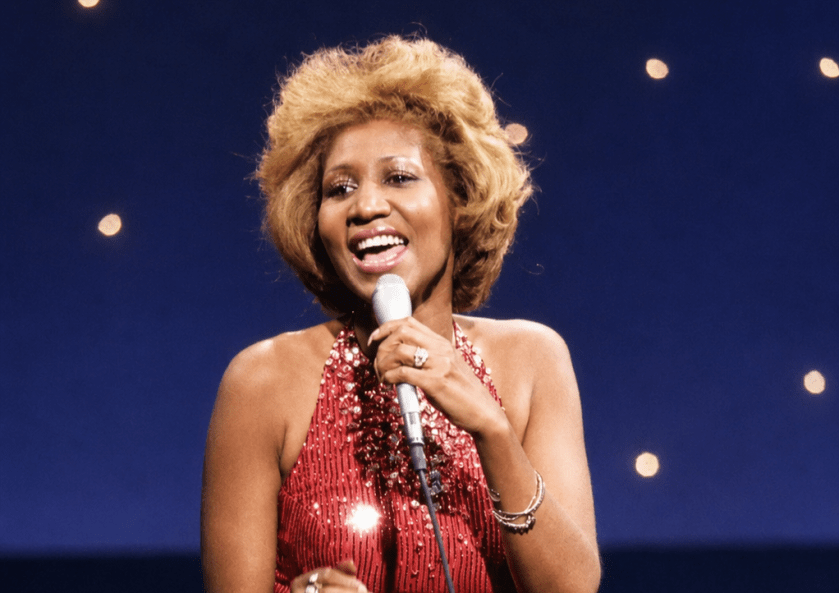
It wasn’t Aretha Franklin’s first sexy song, nor was it her last, but it oozed a sexiness that distinguished it from those before it. She’d delivered sexy as a blues sermon about her man on “Dr. Feelgood (Love Is A Serious Business)” in 1967 and though she made it sizzle when she performed it in 1971 at San Francisco’s Fillmore West. She was more formally R&B later in 1967 when she declared that “Baby, I Love You.” She pontificated about the “Spirit In The Dark” in 1970, which could’ve been sexy or spiritual. A groove she called “Rock Steady” in 1972 adorned the sexy in one of her funkiest rhythms. 1973’s “Master Of Eyes (The Deepness Of Your Eyes).” had her lost in the allure of a gaze. But it was “Something He Can Feel” helmed by the gentle giant Curtis Mayfield which possessed, and still possesses, an inherent sexiness that usurps most other Aretha records.
The convergence of Aretha Franklin and Curtis Mayfield for 1976’s Sparkle was among the most significant musical decisions Aretha Franklin ever made. It momentarily pulled her out of a commercial slump, and birthed one of her most significant albums; the final triumph of her decade plus at Atlantic Records, the label that helped her rocket to the top of the charts. Sparkle’s lead single “Something He Can Feel” was an instant hit, and went on to become a focal point of her catalog.
“Something He Can Feel” starts with a bassline that moves, no, oozes, with sexiness. Can a bassline be sexy, let alone that sexy? When it’s crafted by Curtis in 1976, it sure as hell can. It’s alluring, creating a mesmerizing aura with an implication of “come hither.” Underneath it is the boom of the bass drum, immediately followed by the anticipated resolution of the cymbal tick-tick-ticking and the snare rim’s tap to resolve the measure.
As the introduction unfolds, those piano keys twinkle, at first with glittery magic, and later with palpable urgency. The strings juxtapose a lush, upper echelon sound alongside the lyric about “living in a world of ghetto life” that acknowledges but dismisses the surrounding uptightness and focuses on what’s alright, between two. In some ways it’s aspirational, and implies the transcendent nature that feelings of desire possess, and how that allure can transcend any geographical or economic situation. This is what getting lost in ‘it’ sounds like. What’s the ‘it’? Passion, desire, love. Take your pick. Even though it’s not an outright social pontification as Curtis was often known for, he still wove in there, with subtlety.
The guitar strums, to the left in the mix, glide as if those fingers are gently caressing another’s body. The horns are soulful, but their arrangement possesses a jazzy quality. And then there’s those background vocals, contributed by the Kitty Haywood Singers. Their backgrounds are like the fluff in a cushion that cradles Aretha’s immense and immaculate performance. They weren’t Aretha’s typical background support, but undoubtedly compliment her, harkening back to those vocals from the Sweet Inspirations and her own sisters Erma and Carolyn that underscored many a 1967 and 1968 Aretha recording. Though a Motown and Supremes inspiration permeates across this story and music, this does not try to be Motown. It’s got a doo-wop and pop and soul and gospel and funk convergence that’s all Curtis and his Chicago-born sound.
It’s not just the parts that make up this song, it’s the length, which does matter in this case. Clocking in at 6:21, “Something He Can Feel” is like smoldering embers, instead of the wildfire a radio-friendly record tends to imitate. No, this has a gradual build, and the flames subtly ignite and crescendo into a full blaze, only to just as gently subdue, until they combust, like a fire encountering moisture trapped in the wood. It’s unpredictable, warm, and sizzling, just like a fire.
Which leaves perhaps the most important element of the song, Aretha herself. Aretha didn’t just sink her teeth into the music from “Sparkle” she mercilessly tore into it and tore this shit up piece by piece. Aretha was at a stage where her voice was arguably at its peak in strength and power, and “Something He Can Feel” certainly makes a case for that. Her control is impeccable, and frankly, excuse the vulgarity but she damn near fucks the song herself. It’s a masterwork, and yet another masterclass in soul, emotive, and affecting vocal performance from the Queen of Soul. A polite reminder of why they put that literal crown on her head in Chicago in 1963.
She embodies the urgency and ecstacy that the song implies, effortlessly. As her friend and agent Ruth Bowen recalled to David Ritz in 2014’s Respect: The Life of Aretha Franklin, when Bowen dropped by the sessions for Sparkle, Aretha had seemingly entered another dimension. “This singing was on a whole different level. Girlfriend was shouting. She was going for broke.”
It’s also crucial to understand that Aretha didn’t contribute any lyrics, arrangement, or instrumentation to “Something He Can Feel.” But it’s almost impossible to glean that from this recording. She sounds like she gets fully enveloped by the song. Her runs and vocal prowess are tenacious. Just when you think she’s hit a peak, she outdoes it, and just as easily pulls back. Curtis may have been directing or producing, but like any good producer, there’s no sense of that. Aretha sounds free, even if she’s lost in the song.
The lyrics don’t even fit Aretha like a glove. She’s 33 at the time of recording and singing lyrics that come out of a teenager’s mouth in the film, such as “people say that I’m too young to let you know just where I’m coming from,” not unlike a few years earlier when she was singing “Until You Come Back To Me (That’s What I’m Going To Do),” which Stevie Wonder wrote at age 15 about the determination of a teenager to win their lost love back. But just like then, her delivery here is so immense and impassioned that no one even bats an eye.
I think it made her feel sexy, too. Watching Aretha perform the song over the years, it seems to activate something within her, in a way that not every song could. When she sang gospel, it could, but in a different, more pointedly spiritual way. On the secular side, “I Never Loved A Man (The Way I Love You)” and “Dr. Feelgood (Love Is A Serious Business)” are two others that had a similar effect. Curtis gave Aretha something she could feel. And you see and feel that in the performances. That’s what distinguishes it from much of the material on surrounding albums such as 1975’s You. She felt “Something He Can Feel” and the rest of Sparkle on a deep, molecular level.
Aretha’s longtime agent and friend Ruth Bowen expounded on this in Ritz’s 2014 biography on Aretha, floating the possibility that Aretha fell in love with the material. “People said that Aretha was singing about being in love with Ken Cunningham (her partner at the time), but I don’t agree… She was singing about being in love with these songs. She knew that Curtis had written some of his greatest work, and she was riding those melodies all the way to the moon.”
Watch her perform “Something He Can Feel” on The Tonight Show with Johnny Carson in April 1976 (shout out to my friend Milik Kashad and his Black Music Archive who helped this piece of history reach the digital realm). It’s immense. She’s into it. Part way through the song, she does a 180 and shows off the mostly backless side of her dress, something she hadn’t really done before, and then glides right back around and sinks teeth and gums back into the song. Her ad-libbed “I want my man to know”’s near song’s end are spine-tingling. It’s a physical and physically affecting performance that has her trying to catch her breath after the song winds down.
When she performed it on The Midnight Special later that same year, the performance echoes that same intense connection, with a similar 180 to show off her figure. More than once during this performance, she unleashes a series of runs and kicks her feet back as she finishes them, as if the intensity and power of the music just spanned her entire body, from mouth to foot, and she had to kick back and shake it off.
Later performances still maintain that essence. A 1988 performance in Cincinnati when her vocal range is diminished doesn’t slow her down one bit. Mid-way through the song, she throws her arms up and starts shaking and shimmying, only pausing to deliver a soul-stirring run. Her highs aren’t there, so she goes lower and loses not one ounce of effectiveness. Something overtakes her as she performs it, at one point she turns around, and spanks herself.
In the 2010’s when she performed “Something He Can Feel,” she started trotting out an handful of dancers, dressed in fiery red to mimic the outfits worn in the film and do their own version of the dances seen in the film while the actresses are performing “Something He Can Feel.” It clearly brought her joy, and always won support from the audience.
“Something He Can Feel” was indeed something of a triumph for Aretha. Released on May 5, 1976, it became her only Top 40 hit of the second half of the 1970s, peaking at number 28 on Billboard’s Pop chart. It was also yet another #1 on Billboard’s Soul Singles chart. She had one more number one single on the R&B chart on Atlantic the following year with “Break it To Me Gently,” making 1975 the only year since 1967 that Aretha hadn’t reached the summit of the chart. She wouldn’t return to that summit again until 1982.
“Something He Can Feel” was nominated for a Grammy Award for Best Female R&B Vocal Performance in 1977, which had been known as ‘the Aretha Franklin award.’ She’d won the first award in the category and every subsequent award for 8 consecutive years, remaining undefeated. Aretha wasn’t nominated in 1976, and the award went to a burgeoning Natalie Cole. Unfortunately for Aretha, Natalie notched a second win in 1977 for “Sophisticated Lady (She’s a Different Lady)” marking Aretha’s first formal defeat in the category.
In 1988, Afrika Bambaataa released a cover of the song on his album The Light, assisted by Boy George and LaBelle’s Nona Hendryx.
The real big resurgence for the song arrived 4 years later in 1992. On their sophomore album, girl group En Vogue recorded and released a cover of the song as their second single, retitled “Giving Him Something He Can Feel.” It also hit #1 on the R&B chart, and outperformed Aretha on the pop chart, peaking in the top 10 at #6. It came accompanied by a music video that paid homage to the film’s scene where the girls perform it for the first time, in those iconic red dresses.
20 years later, the 2012 remake of Sparkle starring Whitney Houston in her final film role saw the film’s cast of Carmen Ejogo, Jordin Sparks, and Tika Sumpter deliver their own rendition of the classic.
Though an iconic part of Aretha’s repertoire, there aren’t an abundance of covers out there. Fan footage can be found online of Jennifer Hudson, Fantasia, and K. Michelle all tearing into the song. In 2003, Tamia performed the song in tribute to Aretha at the BET Walk of Fame celebration.
The song even made it to a lip sync for your life on season 2 of RuPaul’s Drag Race.
Aretha worked “Something He Can Feel” in and out of her concert repertoire over the years, but it was a regular piece of her shows. According to setlist.fm, which amasses setlists and setlist data, “Something He Can Feel” was tied as Aretha’s 16th most-performed song. Though the data is incomplete, it’s safe to say that it maintained its significance. In her final year of performing, Aretha performed the song at least half a dozen times. She was still feeling it, 41 years later. Now, that’s something.

