
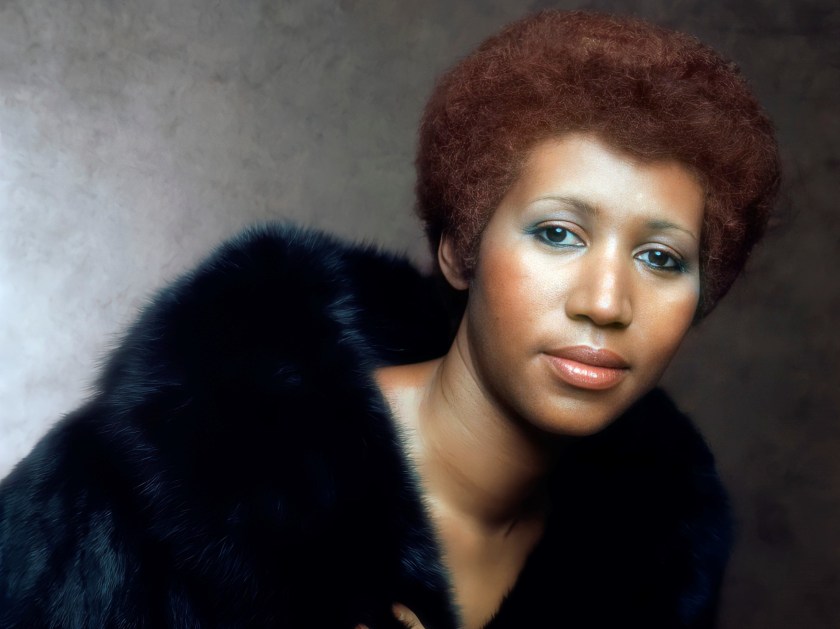
After years of heartbreak and sorrow, Aretha finally found happiness in love in the 1970’s, highlighted by a magnificent cover of “I’m In Love” on 1974’s Let Me In Your Life. But in order to properly tell the story of this song, we have to go back to the origin and its songwriter: the legendary Bobby Womack.
Oh, Bobby Womack. Apparently chaos doesn’t just ensue across 110th street. Researching this one was a doozy. Who’s ready for a wild ride? We’ll get back to Aretha, I swear, but the background of this song couldn’t be skimped on.
Womack wrote “I’m In Love” sometime around 1967 or early 1968. The song is a devotional ode to his wife Barbara, who he married in 1964, Sounds nice enough, right? Wrong. There’s more drama here than pre-2001 Mary J. Blige. Barbara was best known by her first married name, Cooke. She was married to a singer you might have heard of, one Sam Cooke. Yup. That one. Sam was murdered in Los Angeles on December 11, 1964 At that time, Bobby was in Sam’s band. Apparently more than the band was on his mind after Sam’s death. Bobby swears that he reached out to Barbara to be a source of comfort and reassurance in the wake of Sam’s death, and just ended up falling in love. That’s his story and he stuck to it.
77 days after Sam was murdered, Barbara and Bobby tried to get married. They were denied a marriage license because Womack was only 20 years old (Barbara was 30) and at that time parental permission was required to marry if you were under 21 in California. They married 12 days later on March 10, the day after Bobby’s 21st birthday. Bobby wore one of Sam’s suits at Barbara’s request.
Chaos ensued. Bobby’s brothers, who together had been in a group called the Valentinos, distanced themselves from him which in turn caused Bobby to launch his solo career. The court of public opinion was far from in his favor and made that transition a taller order than he could successfully place. Sam Cooke’s brothers, enraged by the marriage, broke his jaw during an altercation at a Chicago hotel. Deejays refused to play his solo single, and he was often reduced to being introduced on stage as “the kid that married Sam Cooke’s wife.” The drama forced Womack to relinquish his solo dreams and fade into the background as a session musician. He even played guitar on the majority of Aretha’s classic Lady Soul LP and a few tracks on the follow-up, Aretha Now.
Despite all of the trials and tribulations, Bobby’s love for Barbara remained strong. Bobby wrote “I’m In Love” in 1967 as a formal proclamation of his not giving a fuck what anyone thinks about his marriage to Barbara. The song is an unapologetic proclamation of love found and embraced, with a loose set of lyrics that were up for augmentation by every artist who got their hands on it. Wilson Pickett recorded the song first, with Bobby accompanying on guitar. Pickett’s recording which was released in 1968. Bobby released his own version the following year on his album Fly Me to the Moon, adding his own embellishments to the lyrics he wrote. Pickett’s version was a minor hit, reaching the top 5 on the R&B chart and top 50 on the pop chart.
Aretha had already conquered a Womack composition the previous year before she seized “I’m In Love.” Her reading of the similarly adoring “That’s The Way I Feel About Cha” on 1973’s Hey Now Hey (The Other Side Of The Sky) was a standout (and coincidentally, a stunning alternate take was released on 2007’s Rare and Unreleased Recordings of the Golden Reign of the Queen of Soul, alongside a glorious alternate take of “I’m In Love”).
Recorded on April 10, 1973 in New York City and released as Let Me In Your Life’s second single on March 18, 1974, Aretha delivered one of her finest covers of the 1970’s in “I’m In Love.” For some reason, it often gets omitted from conversation about her finest works, but it was a triumph sonically and commercially. It reached #1 on the R&B chart and #19 on the pop chart, marking her 8th (and final) consecutive year of scoring a #1 on the R&B chart.
Aretha further emphasizes the euphoric core of the song, opening with a symphony of lush strings and reverberating background “la”’s and “ah”’s that form “love”’s sound cinematic, as if straight out of a classic Disney Princess film. While those opening elements make a strong statement, they fade to the background of the mix for the rest of the song. Instead, the arrangement focuses on electric guitars as was a staple in Pickett and Womack’s version, in addition to new response parts from horns and a light bossa nova groove courtesy of the percussion.
The key change up during the chorus amplifies the feeling, creating a true sonic iteration of the elevated feeling love creates. Aretha also applies a quick key change regression to the end of the chorus that aligns with the one used just a few years earlier in when she recorded her cover of “Groovin” in 1967, on which Bobby played guitar. Perhaps it’s coincidence, perhaps Bobby had a hand in that and Aretha decided to re-apply it here. That progression is unique to her cover of “Groovin,” which was recorded 5 months after Wilson Pickett cut “I’m In Love” with Womack on guitar. Though it’s not used on Pickett’s version of “I’m In Love,” Womack uses it on his.
Nearly 1,000 words and nothing about Aretha’s version of “I’m In Love”? What am I doing? Isn’t that the point of all of this? Let’s dig in. Aretha is brilliant on this cover. Her relationship with Ken Cunningham (which was a few years strong at this point), clearly fuels the fire she ignites here.
Initially Aretha’s delivery is restrained and at times even breathy as she makes her initial statements of “I’m in love.” They’re coy, and somewhat realizing. An early “hm!” even resonates with surprise, as if to say “I’m in love? Me?! Yes, I am!” That grows, crescendoing and intensifying as the song progresses, until she unleashes a series of otherworldly wails to issue what have by this point become declarations. Her vocal delivery is the piece de resistance on this cover, especially as we get deeper in and the joy erupts out of her.
The heavy reverb placed on some of her strongest runs during the climax further crystallizes the cinematic nature of the arrangement. Furthermore, the seemingly absurd, but fully functioning “yes are am”’s (which are more likely a compound of “yes sir I am”) compliment that momentarily mystified “hm!” early on. She also fiddles with the lyrics, as Womack had done before her on his version. Aretha is the first to change the second verse though. Instead of singing about Christmas morning, she simply sings, “and I’m so glad that it’s me that you chose, I’m sprouting and blooming like the last summer rose,” and then vocally lets loose.
As the song unfolds, Aretha overflows with joy. At moments her biggest vocal runs even mimic both the guitars and the horns, a testament to the flexibility of her instrument. Her “yes are am”’s may not be grammatically correct, but damn it if they not only fit, but also stick in the mind. They glide with such conviction and adoration. They were also clearly a mainstay in her iteration of the song, affirmed by the alternative vocal take released on 2007’s Rare & Unreleased Recordings From The Golden Reign Of The Queen of Soul.
That version is just as important as the album version. On the alternate, she delivers a more impassioned and vocally liberated take, in a slightly less produced environment. There’s no build, no tactful, modulating delivery. She charges in, belting for all the world to hear. And while she doesn’t belt the entire vocal, she’s forceful throughout. In their liner notes for Rare & Unreleased, Jerry Wexler and David Ritz proclaim that she “soars to the heavens,” on this take, and they’re certainly right.
It’s fascinating to consider each take on the song. On the album version, she seems to come to the realization that she’s in love and basks in it. On the alternate, she makes a grand proclamation from start to finish. The alternate is also less produced, with no reverb to be found on different vocal pieces. It feels more intimate. Though the album version is more cinematic and unfolds gradually, neither seems more right than the other. They’re both extremely effective in conveying the song’s message. And isn’t that just like love? Sometimes it’s gradual and growing, and other times it’s grandiose from the jump.
Aretha’s voice was peaking during the 70’s, and that’s evidenced by the vocal performances she gives on both takes of “I’m In Love.” There’s power, clarity, soul, definition, control, and depth. It’s no question that she’s in a league of her own with both of these versions.
It’s also worth mentioning that “I’m In Love” was engineered by the legendary Phil Ramone. In the Aretha galaxy Phil would later produce Aretha on her contributions to Frank Sinatra’s 1993 Duets album, “What Now My Love,” and Tony Bennett’s 2011 Duets II album, “How Do You Keep The Music Playing?” and the studio version of her legendary 1998 performance of “Nessun Dorma.” Donny Hathaway is on the piano, and Cissy Houston is among those heavenly background vocalists, alongside Judy Clay, Deidre Tuck, and Gwen Guthrie (who would top the dance charts with 1986’s “Ain’t Nothin’ Goin’ On But The Rent”).
Oh, and to tie together the Bobby Womack storyline… Barbara and Bobby separated in 1970 after Barbara caught Bobby having an affair with her and Sam’s 17-year-old daughter Linda. Barbara even tried to shoot Bobby, and grazed the side of his head with a bullet.
Linda and Bobby didn’t end up working out, but she went on to marry Bobby’s brother Cecil Womack, shortly after Cecil divorced Motown star Mary Wells for having an affair with another Womack brother, Curtis. Linda and Cecil were together until Cecil’s death in 2013. Bobby was married two other times before his death in 2014. Don’t even ask about Harry. Friendly Womack Jr., the last surviving Womack of that generation, released some new gospel music in 2023.
The moral of the story: Love isn’t always forever, but the feelings encapsulated in a song about the moment can be, and can certainly make it feel like it will be. And when Aretha Franklin is feeling that, she will create a definitive version of the song.
Listen to Aretha rise as she falls on “I’m In Love”:
 365 Days of Aretha Franklin
one of her best. Wilson Pickets was a surprise to me just this year! Even though I was a big fan even in the 60s
LikeLike