
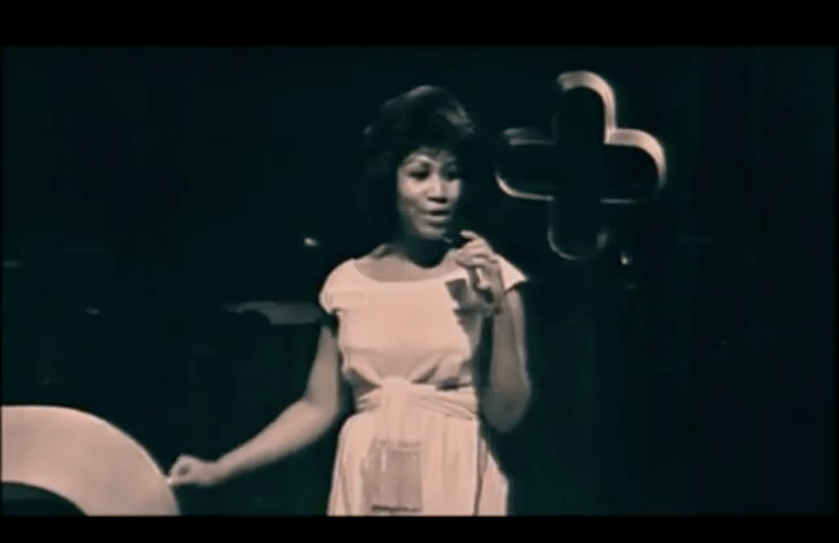
So many of Aretha Franklin’s Columbia-era recordings were subject to haphazard, piecemeal releases over the years, thanks in part to her unsuccessful chase for a hit and stylistic inconsistency. An entire album of material produced by Bobby Scott in 1963 went largely unreleased until years after being recorded, in part because what was supposed to be a jazz record ended up lacking any singular style or cohesive flow. Among the tunes she recorded with Scott during the first of their three-day session on October 9, 1963 was a cover of the seminal classic, “Moon River.” It’s one of the few cuts from their sessions that adheres to the jazz originally tone intended for their collaboration.
“Moon River” holds a rare place in history as one of the few songs to snag the Academy Award for Best Original Song and the Grammy Awards for both Record and Song of the Year. Written by Henry Mancini and Johnny Mercer, the song accentuates the classic 1961 film ‘Breakfast At Tiffany’s.’ In the film, Audrey Hepburn’s Holly Golightly draws the attention of her writer neighbor as she sings the song on her apartment’s fire escape. The song was almost cut from the film (Hepburn responded with “over my dead body” when she became aware of the possible edit), but instead it became a crucial part of the film, and popular music.
Henry Manchini, who was also the film’s score composer, had fought hard to write the film’s featured song in addition to the score. He got his wish, and then he got stuck. What should the character sing? What would she have to say? How would she say it? How well could she sing it?
Mercer wrote three sets of lyrics to the melody, and then decided which one to use for the film.The final selection draws inspiration from his southern roots, and memories of seeing the moon shine over a river near his childhood home in Savannah, Georgia. In arrangement, “Moon River” is pop, but in composition, the song is a waltz.
It’s also a fairly simple song to sing. Mancini tailored the song to Hepburn’s vocal range. He had seen her in a musical not long before the film, and was able tailor everything to her particular vocal abilities.
From there, the song took off. Jerry Butler recorded a version simultaneous to the film’s release that almost cracked the top 10 on the Billboard Hot 100. Andy Williams used the first 8 bars as the theme song to The Andy Williams Show, and of course, there were the aforementioned awards.
“Moon River” became an instantly recognizable song. The list of names who have put their own stamp on the tune includes a who’s who of musical dignitaries, from then and now: Frank Sinatra, Barbara Streisand, Judy Garland, Sarah Vaughan, Andy Williams, Stevie Wonder, Eartha Kitt, Willie Nelson, Rod Stewart, James Taylor, Frank Ocean and even a rap interpolation by A$AP Ferg featuring actress Elle Fanning singing the song’s classic melody. As is common, there are other versions and then there is Aretha’s.
Aretha’s 1963 recording with Bobby Scott is among the jazziest interpretations of the song, abandoning any sense of the waltz it once was. It draws loosely on the beginning of Art Blakey and the Jazz Messengers’ version, which was recorded in 1961, but not released until July 1963. It wouldn’t be hard to hear Ella Fitzgerald seizing an arrangement like this, clearly a stylistic influencer to Aretha’s. The only other stylistic rival to Aretha’s is Nancy Wilson’s 1963 rendition, which hinges more on a bossa nova groove. Most of the others by well-known names are very traditional pop/easy listening rooted. Sarah Vaughan’s naturally has a touch of jazz to it, but just a touch.
Aretha’s version opens with a sweeping big-band brass introduction, before staccato notes give way to a lively jazz arrangement with walking bass, punchy brass accents. 21 year-old Aretha glides over the band, as they build into ending that isn’t shy about hinting at her capacity to blow Hepburn out of the water in one sweeping exhale. The arrangement gives her room to play with the phrasing and display her ability to effortlessly bend notes from one to the other and back again.
As a result of the sessions veering off stylistic course, the resulting album’s worth of material is far from cohesive, and was shelved. Only one song from the sessions was released, and that was after Aretha departed Columbia and achieved success on Atlantic Records in 1967. “Moon River” was released on a little-known 1969 compilation called Once In A Lifetime, on Columbia’s Harmony Records imprint. The song was then included on a 1997 compilation called Aretha Franklin Sings Standards, before receiving a wider release as part of the 2011 box set Take A Look: Aretha Franklin Complete on Columbia. That box set compiled all the tracks Aretha cut with Bobby Scott for the first time, on a disc called Tiny Sparrow: The Bobby Scott Sessions.
Fascinatingly, despite not being released at the time, there is footage of Aretha performing “Moon River” in 1964 on The Steve Allen Show. At the time, she was promoting Unforgettable: A Tribute To Dinah Washington, which is shown before Aretha begins performing. It’s a knockout performance that incorporates both elements from the recording and Aretha’s expected improvisations and on-the-fly embellishments. I’ve seen the full thing, but it’s not mine to share. For now, here’s a clip:
2024 update: Here’s the full performance!
Stream and download Aretha’s “Moon River” & Tiny Sparrow: The Bobby Scott Sessions
 365 Days of Aretha Franklin